What Young Hockey Players Can Learn From the NHL Playoffs
Young players can learn the game in its purest form during the NHL playoffs. The competition is at its highest, players are at their best, and habits and routines are on full display. Good habits and routines win out over poor habits and routines. When players are as skilled as they are in the NHL and want to win as badly as they do, the difference between winning and losing often comes down to habits, routines, and execution.
Young players watching playoff hockey can learn how to prepare themselves for success in big moments by observing, noting, and implementing the habits and routines of successful playoff players.
Young hockey players can improve Hockey IQ, decision-making, and game habits by studying the details, routines, and positioning displayed during the NHL playoffs.
Watch the Game Away From the Puck
Young players watching the playoffs should pay close attention to play away from the puck and the habits of successful players during and before games. These habits include how a player prepares for the game, their next shift, and faceoffs. How is the player’s body language? Where does their attention seem to be? How do they react to good and bad moments? Are they talking or silent, and why?
Observing the habits of successful playoff players is step one to emulating these traits. Be a note freak. No matter how small or insignificant the detail may seem, write it down.
How Great Players Create Time and Space
An area to focus on for note taking is how good players create time and space. Good players create time and space by controlling the projection of body position. Good players will show their opposition one or multiple options and sell them on the wrong one. Little details such as the direction a player’s skates are pointing, where a player’s chest is facing, and how a player presents their stick pay massive dividends in opening time and space.
Good players are able to control the speed and direction of their opposition, which provides them with time and space to make decisions and execute them. This is a major part of developing true Hockey IQ and understanding how the game is actually played.
This is also why purposeful hockey video analysis can be so valuable for young players. Breaking down shifts, habits, reads, and positioning helps players recognize patterns that are difficult to notice in real time. At Art of Hockey, our Insights video analysis is designed to help players better understand the game, improve decision-making under pressure, and develop habits that transfer directly into games.
Habits That Show Up in Big Moments
Specific habits that are present in successful playoff players include:
Forward thinking
Positivity
Communication
Forward Thinking After Every Shift
Focus is essential in big moments. It is easy to get distracted by the moment and the other elements associated with it. Focus can be maintained and turned into a habit by having a forward-thinking mindset.
Dwelling on or overthinking any play, positive or negative, will negatively impact a player’s ability to stay forward thinking. Thoughts about the past in these moments are distractions unless they are actively helping the player devise a plan for the next shift.
For example, if a goal against is scored, it has already happened. It is done. The only reason to think about the goal is to make a note about how to prevent a similar situation if it arises again. Thoughts then have to move toward how to respond and create offense the other way.
Positivity and Communication Matter
Positivity and communication can help teammates maintain good habits and routines. Groups succeed when they want to succeed for each other, not just themselves. Making positivity and encouragement part of a player’s habits helps teammates maintain confidence and composure in high-pressure moments.
These traits, along with forward thinking, allow teams to have success in the playoffs.
Build Your Own Game-Day Routine
Youth players can practice mimicking almost every aspect of preparation and habit building displayed by NHL players. Players can mimic the mental preparation of NHL players by creating a pregame routine and adapting it over time to find what works best for them.
This pregame routine should prepare the player to be mentally and physically ready for their specific role on the team.
Reset Between Shifts and Periods
Another major opportunity for developing good habits is the routine between shifts. This is an essential piece of the mental side of hockey. What good is getting hyped up and focused for the game if that focus disappears after the first two or three shifts?
Players, youth or professional, need routines between shifts and periods that help keep them in the right mindset to read the game, make decisions, and execute under pressure.
Watch Hockey With Purpose
Finally, watching hockey is one of the best ways to improve Hockey IQ, but there has to be purpose behind it. The observer has to watch for something specific.
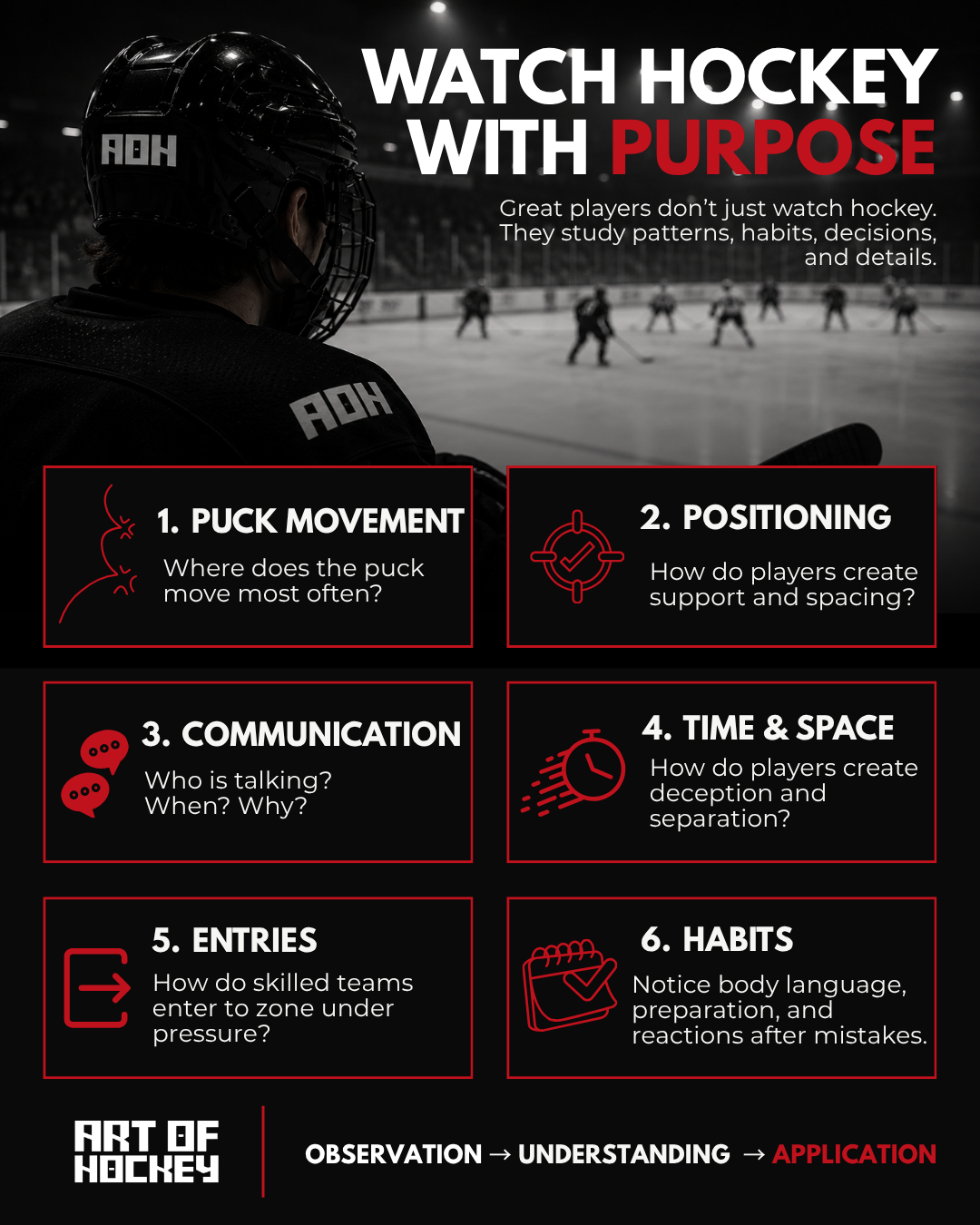
Watching hockey with purpose helps players develop Hockey IQ by learning to recognize patterns, habits, positioning, communication, and decision-making in real game situations.
Prior to the game, a period, or even a shift, a specific aspect of the game should be chosen to observe. For example, if a player wants to understand where the puck typically moves in the offensive zone for one of the highest-scoring teams in the playoffs, they should have a notepad ready and trace where the puck moves throughout the shift.
Once the shift is over, they can look down and identify the areas that were used most often. From there, they can begin understanding why those areas create offense and how those concepts can apply to their own game.
Turn Observation Into Hockey IQ
This is one of the best ways young players can improve their Hockey IQ and begin seeing the game the way high-level players do.
A team’s habits affect each player’s habits, and each player’s habits affect the team.
See the Game Differently
Watching playoff hockey with purpose is one way players can build better habits, improve Hockey IQ, and start recognizing the details that separate good players from great ones.
At Art of Hockey, we help players take that next step through video analysis and game-transfer training built around how hockey is actually played.
Want to better understand your game?