What Is Game-Transfer Hockey Training?
Consistency is one of the hardest things for hockey players to build. Game-transfer training helps players connect skills, decisions, and execution so their development shows up when the game gets unpredictable.
Game-transfer hockey training connects practice reps to real game situations, helping players build confidence, decision-making, and consistency.
Why Consistency Is So Hard in Hockey
A major struggle for every athlete is consistency. Consistency dictates paychecks, playing time, confidence, and trust and lack of it can diminish an athlete’s stature in the eyes of coaches, peers, and spectators. This is true of all athletes from professionals to young athletes just learning their sport.
The struggle for consistent performances dictates the life-span of an athlete in their sport. Those that produce consistently move on to higher echelons and those that don’t either stay put or lose a spot.
Hockey players, specifically, struggle with finding consistency. We play a very unpredictable game and unpredictability creates the perfect environment for inconsistency. Even the best players in the world, who have been training their entire lives, still struggle with being consistent. Yet, they are the best players in the world because they struggle the least with it.
Stringing long streaks of consistency together showcases an ability to adapt to most if not all challenges that are presented. Players who are able to problem solve quickest AND execute their solution are best suited to be consistent performers.
How does one develop this ability? There are multiple methods for developing this ability in an athlete’s game and one of them is game-transfer training.
What Game-Transfer Hockey Training Means
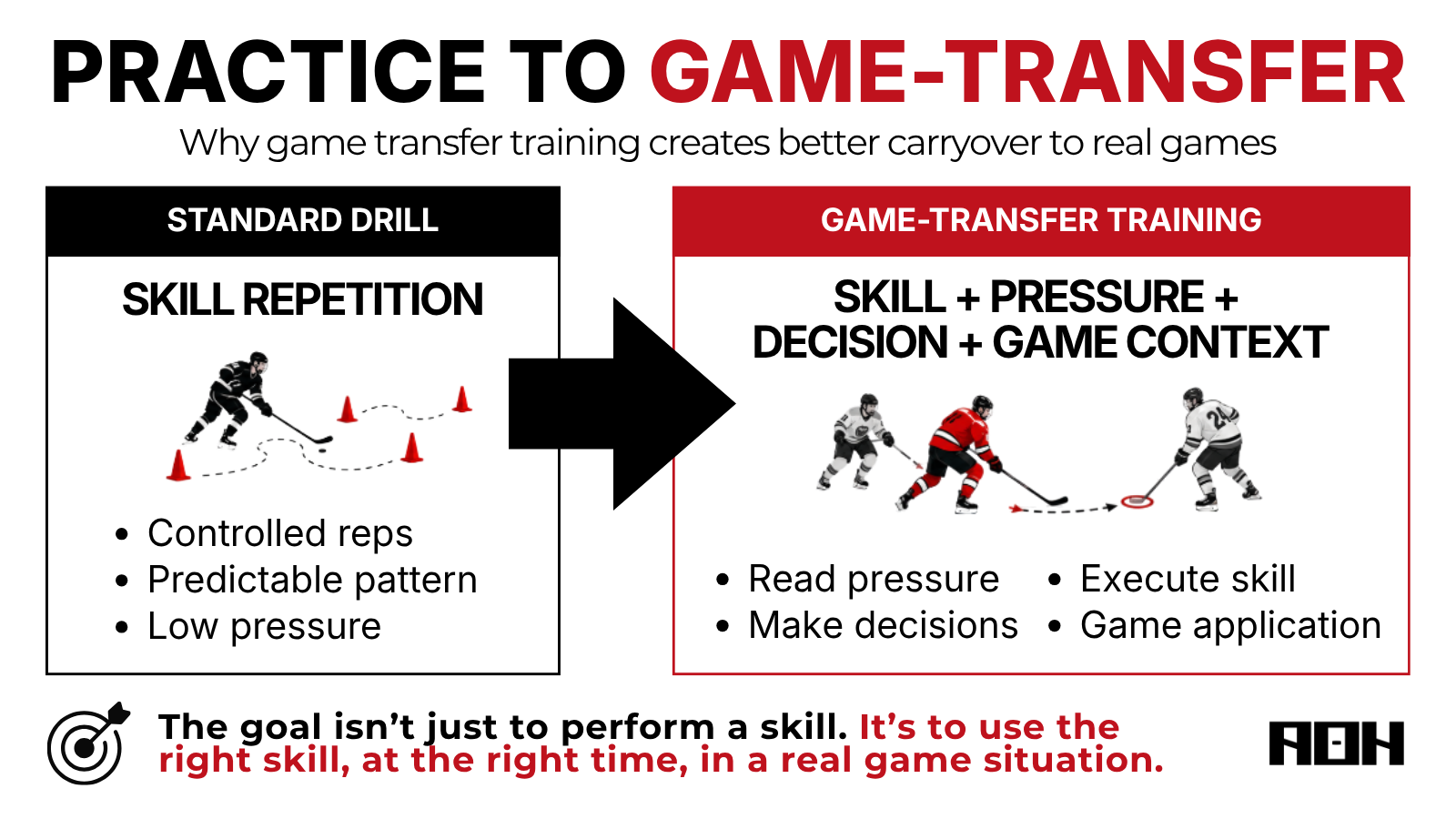
Practice should do more than build skills. Game-transfer training helps players use the right skill, at the right time, in real game situations.
Game-transfer training refers to the type of training or practice a player does that allows them to see in-game results quickly. What is done in training or practice is being done to improve the quality of a player in a game.
A game-transfer approach uses training and practice methods that blurs the line between practice/training and the game, which accelerates player development and promotes consistency.
Game-transfer training also uses methods that promote quick decisions and creativity which also promotes consistent performances.
Why Game-Transfer Training Is Different From Drills
Game-transfer training is different from doing drills in that it provides more than just developing a skill.
Game-transfer training for hockey:
promotes skill selection as well as skill execution, whereas standard drills only provide skill execution, and
allows players to develop skills in game-like scenarios, which allows them to build confidence and trust in their training through seeing quicker and longer-lasting results.
Decision-Making Comes Before Execution
These quick decisions matter because they happen before a player physically executes a play. It’s hard to cook a meal if the cook doesn't know what they’re making. Just like it is hard to execute a pass if a player doesn’t know when or where the pass needs to go.
Game-transfer training values both decision-making and execution and focuses on developing both in conjunction with each other. The ability to make these quick decisions and execute them gives players a weapon to use against the daily beast of inconsistency.
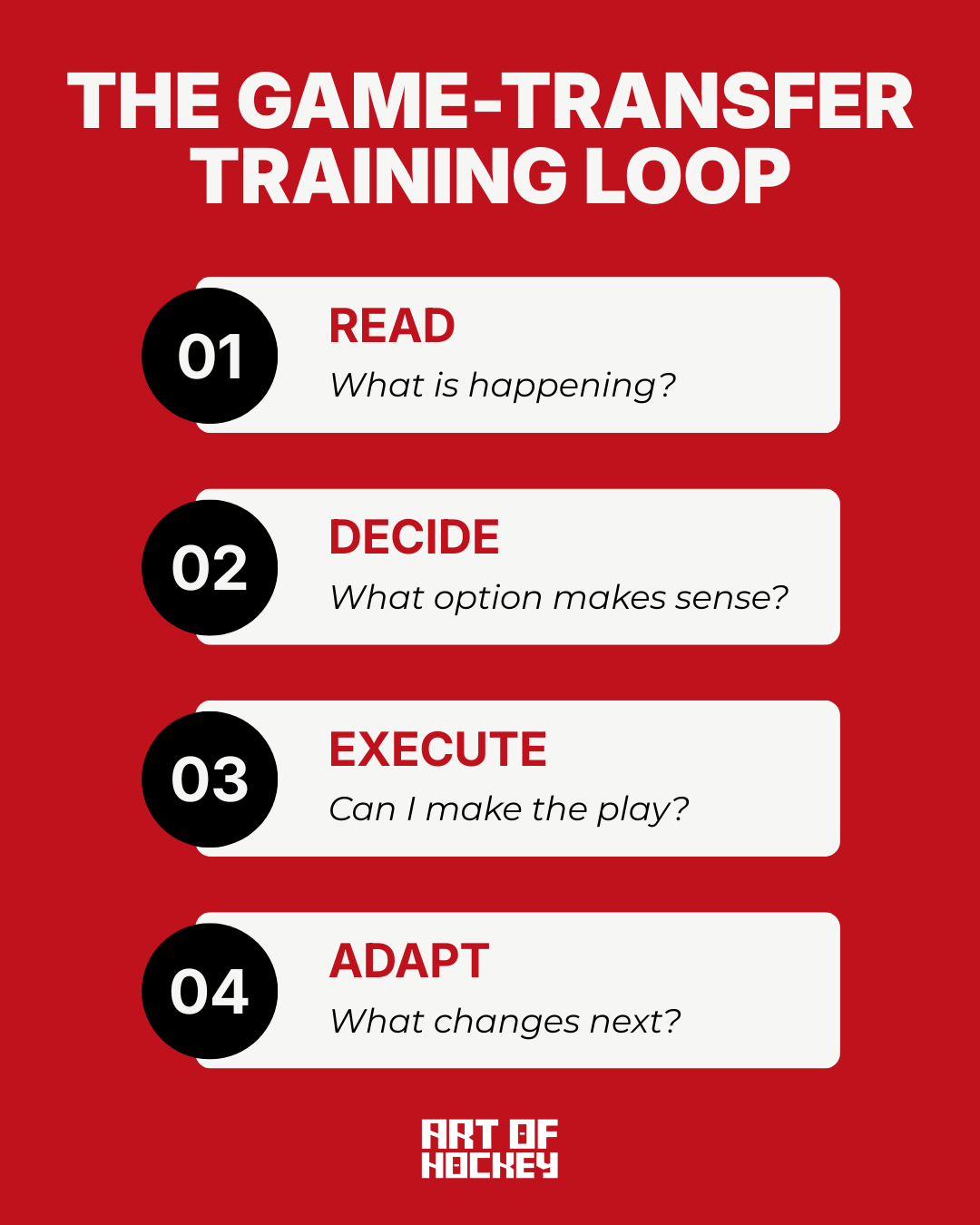
Game-transfer training helps players read the game, make decisions, execute skills, and adapt as the play changes.
A Game-Transfer Training Example
A game-transfer approach in a training session will focus on the development of a skill in a game-like scenario.
For example, if a defenseman wants to work on their backward to forward transition, game-transfer training will feature a drill where a puck is dumped into the corner and the player will skate backward and transition to forwards to pick it up and make a breakout pass. Different elements of this play will be coaching points and the drill may evolve to meet the needs of the player, but the transition will remain the focus.
Forechecking pressure may also be provided in this example to allow the defenseman to make a decision of when and how to transition based on the direction, speed, and positioning of the forechecker.
By training with this defenseman using the game-transfer approach, this defenseman will learn the skill of backward to forward transition and at the same time, will know how to apply the skill in a game.
How Art of Hockey Uses Game-Transfer Training
Art of Hockey uses game-transfer training in the following areas:
Small Group Training
We focus on game-like scenarios and teach players the skills required to be successful in these scenarios.
In addition to teaching the necessary skills, we focus heavily on options, reads, and decisions in these scenarios.
Clinics
We create a plan for each clinic that enhances a specific skill-set and teaches players how to use this skill in game-like situations.
Camps
Within our camps, Art of Hockey utilizes the implementation of game-transfer training by having classroom sessions that connect to our on-ice and off-ice plans.
This approach creates an environment that promotes growth in the areas of consistency and confidence.
Video Analysis
Art of Hockey provides the game-transfer training approach through video analysis by primarily focusing on the decisions made.
Taking this approach, players having their video analysis can expect to be given new ideas about how to improve their game or tweak the ideas they have already to better execute them.
Why Game-Transfer Training Builds Confidence and Consistency
Game-transfer training makes practice feel like a game and a game feel like practice.
I’ve seen countless players that look better in practice than they do in games and it is frustrating for all parties, but mostly the player. Game-transfer training blurs the line between practice and game, which creates a mindset of hard-work, creativity, and execution. This blur connects performance in practice to performance in games which creates consistency and confidence.
Those looking for quality hockey training should see players showcasing their confidence and consistency. These two qualities are possessed by every elite athlete in every sport. Players should be as good, if not better, in games than they are in practice, if their training is high quality as this showcases consistency and confidence.
Finally, drills are valuable for learning and developing new skills, but often context can be lost in this process. What good is it to practice shooting and get very good at shooting if a player can’t shoot with pressure on them or while off balance? None. It does none, because we play a physical game that requires a combination of skill selection AND execution.
Game-transfer training creates players that are skilled and can use their skills when they are needed.
Ready to Train With More Purpose?
Want training that connects directly to game situations? Explore Art of Hockey training options or submit game film for a personalized video analysis.